
Choosing the Right Isolation Level in Distributed Databases
Why “strong consistency” doesn’t always scale — and practical trade-offs to know 🛠️

Who this is for
If you’re working on backend systems, data services, or distributed databases, and you want a clear, realistic breakdown of transaction isolation levels — this article is for you. We’ll keep it technical but approachable for intermediate-to-advanced developers.
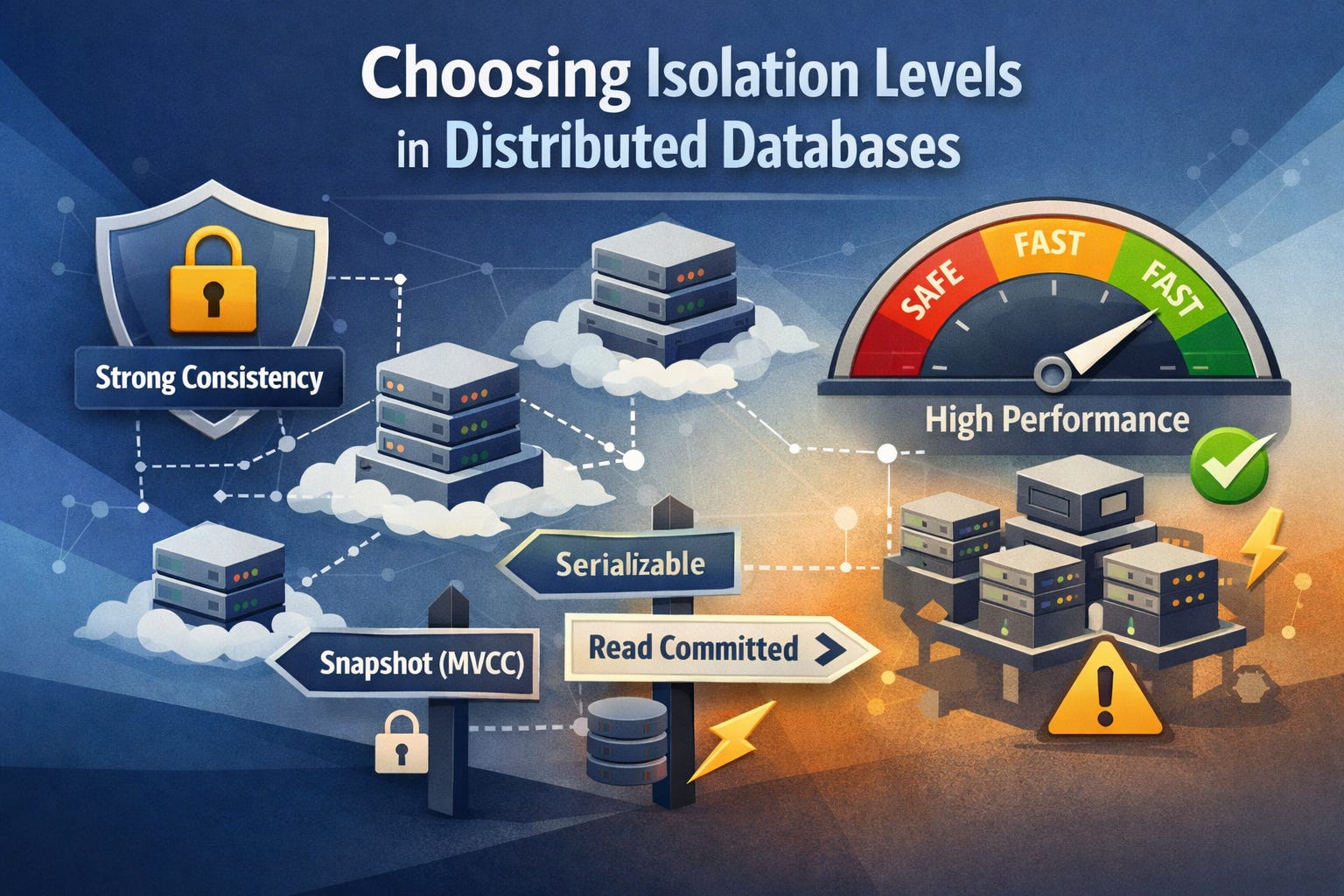
Why isolation levels matter in distributed systems
In single-node databases, the isolation level controls how transactions see and interact with each other’s work. In distributed systems (multiple shards, nodes, regions), those guarantees become much harder to maintain — and the costs (latency, contention, availability) can grow rapidly.
When you pick an isolation level, you’re balancing consistency, concurrency, and scalability. If you pick too strong a guarantee, you may kill throughput. Too weak — you risk subtle correctness bugs. Let’s walk through some real-world scenarios.
Use-cases to keep in mind
Use Case A: Banking / critical update
Imagine a transaction to withdraw from a bank account:
Begin transaction
Read user’s balance
Record an activity entry (log)
Update the user’s balance = old_balance minus amount
Commit
Here you must not allow stale balance reads or concurrent writes to introduce incorrect states.
Use Case B: Retail / best-effort read
Consider a transaction creating an order in a retail system:
Begin transaction
Read exchange _rate table
Create an order row
Commit
In this case: if the exchange rate changes shortly after you read it, it’s not a fatal flaw. You want low latency and high throughput, and you’re okay with the “latest” value being slightly stale.
These two examples illustrate contrasting demands: one demands strict correctness, the other tolerates some looseness in exchange for speed.
Serializable isolation — the gold standard (and its cost)
Serializable is the isolation level that most directly matches the theoretical ACID-transaction model: if you ran two transactions in parallel, it should look like some serial order.
✅ Pros:
Strongest guarantee. No interference between concurrent transactions.
In banking-style workloads (Use Case A), this is perfect.
⚠️ Cons (especially in distributed systems):
It often requires global locks or coordination → high latency and reduced concurrency.
Deadlocks become frequent (e.g., when two transactions concurrently read the same row and both attempt updates, leading to lock-upgrade contests).
In the retail example (Use Case B) it slows performance: the currency rate updater may get blocked by a long transaction, hurting scalability.
In distributed systems spanning shards, you hit coordination costs. You often need a global clock or centralized concurrency control.
Bottom line: Serializable gives you the strongest correctness, but in distributed, high-throughput systems it’s often too heavy.
“Repeatable Read” and “Snapshot Read” — medium trade-offs
Repeatable Read
This is often ambiguous. Some systems treat it almost like Serializable; others not so much. In many cases, you inherit the same issues as Serializable.
Snapshot Read (aka MVCC)
Rather than locking everything, the database takes a snapshot at the start of the transaction (Multi-Version Concurrency Control). Reads go against that snapshot (no locking), writes must respect strict rules.
Where it shines: read-only workloads, analytics, streaming workloads (you want a consistent view).
Where it falls short: when you’re doing writes and you care about reading “what just changed”, snapshot doesn’t handle fresh updates like a locking based scheme would. Basically: it gives you consistency for reads, but not strong guarantees for interleaved reads & writes.
In distributed systems, implementing SnapshotRead is still challenging: you still need ordering across shards or globally consistent time. That coupling costs you.
Read Committed & Read Uncommitted — the lightweight options
Read Committed
This isolation level continuously shows you the latest committed state of the database. You may see different values each time you read the same row in a transaction.
✅ Pros:
Low contention, high concurrency.
Works well when you don’t require rigid snapshot consistency.
You can still acquire explicit locks when needed (“select … for update”) to escalate to stronger guarantees for specific rows.
⚠️ Cons:
You can suffer anomalies if your application assumes stale data won’t change behind the scenes. You might need to design around that.
Read Uncommitted
This is the weakest — you may see data that hasn’t even committed yet. Generally unsafe in both monolithic and distributed systems.
Distributed transactions & shard-spanning workloads
If you’re dealing with multi-shard / multi-node systems, you must factor in distributed transactions (two-phase commit, etc). These amplify costs associated with isolation levels. Some key points:
A 2PC (two-phase commit) requires metadata persistence, prepare and commit phases, and works poorly under failures.
Isolation guarantees and distributed commit semantics interact: for example, if one shard commits and another delays, you must prevent applications from seeing partial state. That adds complexity.
Using high isolation + distributed transactions = high latency + weak availability (because you’re bound by the slowest shard) → this conflicts with scalability.
Implication: In a distributed system, stronger isolation levels and cross-shard transactions significantly reduce scalability. You need to consciously design around that.
Practical recommendations for developers
Here are actionable guidelines:
Start with the lowest isolation you can tolerate. If you can safely run at Read Committed, you’ll get better throughput and simpler infrastructure. ✅
Use stronger isolation only when necessary. If you have a banking use case (balance updates, inventory control, etc) that absolutely requires freshness and consistency, then Serializable or SnapshotRead might be justified.
Avoid multi-statement, cross-shard transactions if possible. Keep related data co-located on the same shard so you avoid distributed transaction overhead.
Use explicit locking/upgrades when needed. Even if you use Read Committed, you can employ “select … for update” or equivalent to enforce stronger guarantees only where business logic demands it.
Architect your system around the trade-offs. If you’re choosing a distributed database, anticipate the coupling vs latency issue — don’t assume you’ll get monolithic-database isolation at the same scale.
Invest in monitoring and testing. Observing actual anomalies (e.g., stale reads, lost updates, deadlocks) helps you validate that your chosen isolation serves your business needs without over-engineering.
Key takeaways
Scalability in distributed databases often means accepting weaker isolation or localising updates to avoid coordination.
Serializable is tempting but often impractical at scale due to locks, deadlocks, and latency.
Snapshot/MVCC helps with reads but may not fully help for write-heavy or interleaved read/write workloads.
Read Committed is often the sweet spot for general use. Use stronger isolation selectively.
Avoid cross-shard, multi-statement transactions when you can — they introduce significant overhead.
Be deliberate: choose the isolation level based on what your system can handle, not just what sounds “safest”.
🔍 TL;DR Summary
In distributed systems, high isolation levels (Serializable, Repeatable Read) hinder throughput and scalability.
Snapshot isolation (MVCC) is strong for consistent reads, but doesn’t solve all write-territory issues.
Read Committed wins for general purpose transactions due to lower overhead and higher throughput.
Avoid cross-shard transactions; keep related data together to minimize coordination costs.
Choose the isolation level that fits your consistency requirements and scalability constraints.